
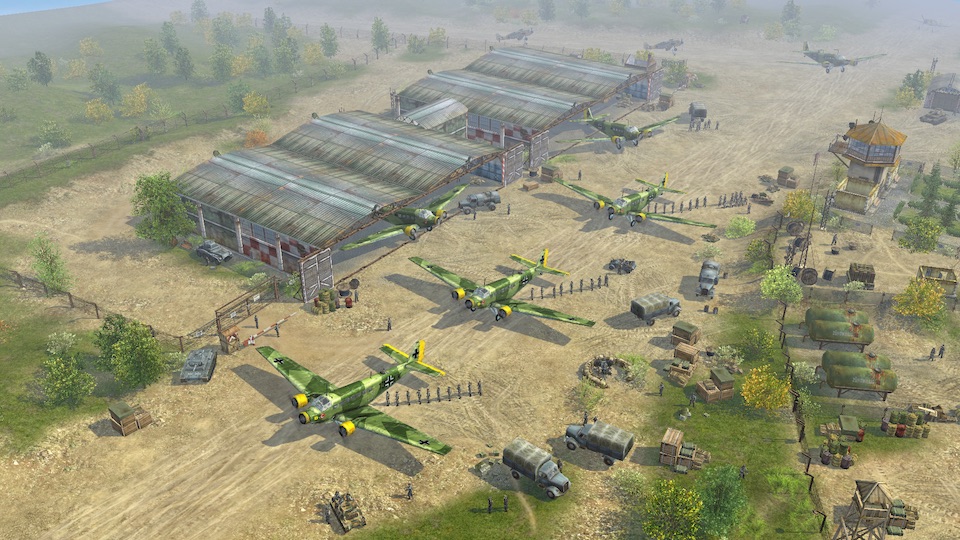


As a direct sequel to Men of War
the game features new mechanics and modes and is set on the Eastern and Western Fronts of World War II

Our History
-
1999: The Birth of Best Way

Best Way game development studio was founded in 1999. It was located in Sievierodonetsk, a small industrial city in eastern Ukraine with many talented IT engineers.
Dmytro Morozov. A decent man. Who had created a profitable business and eventually became a little bored. Dmytro was a daydreamer. He was into playing video games and dreamed of creating his own virtual worlds. But in the city there was nearly no one who knew anything about creating games.
Nevertheless, he was to build a team of creative open-minded people. And he did manage that. A programmer, an artist, and the director. That’s how it all started. Even the longest road begins with a small step…
-
2000: Path Finding

Best Way team had to start from scratch. They dug around. They tried a few existing engines just to figure out none of them would satisfy the thirst. Dmytro had a very high bar, though his concept was still taking shape. Thus the need for their own engine became very clear.
It was an era before graphics hardware acceleration became common. Popular games were mostly 2D or 2.5D. But the advent of the third dimension was already in the air. Experiments with voxels (volume pixels) were ultimately put aside in the favor of mixing 2D and 3D graphic assets.
A creative search for the setting was also taking place. Space adventures, orbital battles, spaceship crafting, interstellar traveling – the team was obsessed with such topics. They moved blindly yet decisively. Prototype after prototype. On and on and on.
-
2001: Sci-fi endeavor

The team was working hard on their own game engine that utilized DirectX 6 and 7. The engine rendered voxel models and tile-based landscapes.
A concept of strategic gameplay was also in development. Similar in a way to the one in Dune 2, but instead of developing player bases it mainly focused on tactics with advanced physics and ballistics. The MVP contained a level representing some distant extraterrestrial planet. A group of space marines were searching for the scientists who mysteriously disappeared. They encountered an aggressive alien species and fought them. When the battle became unbearably tough, the geologist, a powerful NPC who arrived on a shuttle, helped the marines to get rid of the nasty aliens.
The demo was fully playable from initial team setup to the end. Rather interesting than stunning. Best Way wanted much more.
-
2002: Paradigm Shift

While the sci-fi theme remained attractive to many of the team members, deep inside, it felt a bit wrong. It led nowhere. They needed something different.
A turning point for the studio became a prototype in which World War II tanks moved along chains of waypoints and then fired at specified targets. Dmytro’s idea was the ability of moving a tank with arrow keys, guiding its gun with the mouse, and firing with the mouse button.
In other words, to control the player’s unit in a shooter style while remaining in a top-down view. This approach, eventually called Direct Control, would become a signature feature of all Best Way games.
-
2003: Breakthrough

A few years of searching and learning, trying this and that, had passed. The pillars of the future game had finally taken shape and were ultimately embodied in a fully playable demo representing 3 battles that took place in Ukraine during World War II. It looked fresh, bold, original. The only question left on the table was about scaling that approach into a commercial product.
When the disc with the demo reached 1C Company, the publisher instantly recognized the potential. Within a couple of weeks the publisher’s folks arrived in Sievierodonetsk through the abandoned mines of Donbas. The reason was to sign an agreement in person for publishing Soldiers: Heroes of World War II, which happened to be Best Way’s first game. It was the beginning of the franchise history now known as Men of War.
In March 2003, at the International Game Developers Conference, the demo received the award Best Foreign Game, drawing the attention of Codemasters, a British publisher.
-
2004: Legend Arising

Best Way was busy working on their very first commercial product – Soldiers: Heroes of World War II. While finalizing the game, Best Way published a warm-up product. A demo with a single mission called Officer. It quickly became very popular. Despite having only one playable mission it seemed endless in terms of replayability and modification. And heated up players’ anticipation for the game release.
Before long the work was done. Best Way managed to release Soldiers. It was the thing! It won players’ hearts. It amazed influencers. Reviews ranged from strongly positive to awesome. The game was noted for interactive and fully destructible environments, freedom in how to complete missions, bold experiments with RTS clichés.
Soldiers sat among top sellers for weeks across Western Europe and the ex-USSR.
-
2005: Under the Spotlight of Glory

Success of Soldiers: Heroes of World War II turned Best Way from a promising indie team into a prominent game developer. The employees woke up famous and rich (joke). However, paths of Best Way and Codemasters had diverged so that Soldiers 2 did not happen.
Yet you can’t afford to stay still for long because of dynamics and competition in the industry. You have to move forward, always. So Best Way did. But attempts to simply evolve original game mechanics did not satisfy Best Way’s creative director. He did not want just another game. Though it would have sufficed for others. In fact Soldiers’ engine, further called GEM1, was licensed to 3rd parties. Due to that, Saboteurs, a spin-off series, was created.
Best Way, however, decided to move further. So a bunch of serious (but not radical) changes were green-lighted.
-
2006: Stick to their guns

During 2005 and 2006 the new game, Faces of War, received several major awards and became one of the most anticipated RTS titles. Published by Ubisoft and 1C Company, the game had to be released in spring 2006. But the release milestone was too ambitious. Some major systems weren’t going to be ready. Trying to keep the schedule on track, the publisher suggested feature cuts. Best Way insisted on releasing only when the whole thing was done. The publisher wasn’t happy. The release was moved from spring to fall 2006. The original PR plan was heavily cut. Fines were applied, too.
There was another thing. Faces of War was pictured as a sequel to Soldiers. It was partially true. The game inherited pillar mechanics including Direct Control. But in fact it offered a new gameplay experience, in a way, more casual. Which worked like a schism. Casual players welcomed the changes, while hardcore fans remained dogmatic about the original formula. A lot of heat was emitted across gaming forums and communities. Best Way had the old game with its fans, the new game with its fans, and a need to choose its further direction.
-
2007: Forking of the way

If you follow the storyline, it should not surprise you that Best Way chose a new way instead of simply working on “Soldiers 3”. It was about creating a standalone add-on, stepping back into “realism” with more micromanagement.
It was precise and tricky work, setting a fine balance between visual quality and massive battle performance, advanced micromanagement and lowering the entry bar, and many other contrasts. A German game development studio, DigitalMindSoft, joined the new project as a co-dev, focusing on bonus missions, authentic sound design, and narrative.
The current-generation engine was called GEM2. Also, a small group started exploring beyond the horizon. In other words, a next-generation engine, GEM3, which could be cross-platform, available for licensing to third-party developers, and suitable for a 3rd-person view.
-
2008: Hail to Men of War

The new game, Men of War, was a success. Reviews were mostly positive, including from the editor-in-chief on Eurogamer. Reached 80 on Metascore, the game became a benchmark of the tactical action genre.
It was an entangled release, because in the Ex-USSR it was distributed as add-ons to the existing brand Outfront 2, Brother in Arms (2007) and Desert Fox (2008). While in the world it was a completely new brand.
Work on the next-gen engine also bore its first major fruit. The engine was chosen for the remake of fantasy kingdom simulator Majesty 2. That was a remarkable deal, because in terms of the setting and indirect control Majesty 2 was quite the opposite to Best Way brands.
-
2009: At the Beginning Once Again

At this point you would be able to grasp the movement. A kind of spiral one… OK, so here we were. A whole new series of experiments was happening at that time, which ended up producing several videos demonstrating various settings and gameplay mechanics. Some of them turned back to Sci-Fi genres. In those days GEM3 looked promising, so even more resources were devoted to its further development.
Meanwhile, Majesty 2: Fantasy Kingdom Sim, developed by Ino-Co, became the first major title powered by GEM3 (not really though, it was GEM2.5) and was released in September 2009.
On the other side of the coin, GEM2 was conquering the strategy genre, not only with Men of War: Red Tide, but also by promoting the Men of War brand.
-
2011: A new way

Development of the next-gen engine GEM3 continued. At that point the engine’s editor got a significant performance boost and improvements relieving designers’ daily routine. It could load a simple level literally in a few seconds. Huge lists (i.e. with all the entities) updated in a lazy way utilizing multi-threading. Work with localization was simplified.
Due to the successful launch of Majesty 2, Best Way received a proposal to create a third-person view RPG set in a post apocalyptic world followed by alternative history.
This was quite unexpected, as the studio was known primarily for strategy games. Nevertheless, the team accepted the challenge. GEM3 already opened opportunities for realizing bold ideas, and its technological level was comparable to the leading game engines of that period.
-
2012: A Way of Publishing

The new RPG game was announced under the name Nuclear Union. Most of the team was involved in its development.
Meanwhile, at the end of 2011, a group of enthusiasts reached out to Best Way with an idea for a full-fledged game about the Great War titled Battle of Empires: 1914-1918. They didn’t come empty-handed; in fact, they already had a solid mod for Men of War.
Not only did the studio grant a license to use GEM2, but it also took on publishing responsibilities, helping the group bring the project to a commercial level. The gossip quickly spread through the community, and before long Best Way received a bunch of requests from indie teams interested in licensing GEM2. The stars had aligned, so the company established its own publishing department, discovering a whole new dimension of activity.
-
2013: Turbulence

Popular discontent grew into revolutionary sentiments in Ukraine. There was a strong feeling of insecurity here.
In the foreground the development of Nuclear Union was going on, investigating mechanics of nearly frozen time (Bullet time). From the team’s perspective it could become one of the pillars of battle gameplay. Unfortunately, the game lost its funding. Best Way tried to continue developing the game independently while simultaneously seeking new investors or a publisher to complete the project.
In the background a storm was likely coming…
-
2014: Jump Into The Void

Events moved quickly. Euromaidan turned into the Revolution of Dignity. Then came the government’s escape. And the military invasion right after. Sievierodonetsk came under occupation by hostile forces. It was necessary to relocate the team, find a new home, and settle there.
After the cancellation of Nuclear Union, Best Way continued work on a post-apocalyptic third-person RPG codenamed Project 5, offering greater freedom of action, more varied playthroughs, and a new character control system based on giving orders during Bullet Time. A demo was shown at an international game developers’ conference in hopes of finding a publisher or investor; however, the project’s scale seemed too ambitious for a small team, and the risks were deemed too high.
-
2015: Backtrack

In December 2014, Best Way’s publishing division pushed Battle of Empires, developed by Great War Team, into Steam Early Access. Support for external studios developing games on GEM2 was expanded. Among them were the projects Gates of Hell and Draft Wars, both submitted for voting on Steam Greenlight in the summer.
On the main track, Best Way froze all development of the GEM3 engine and related projects, shifting its focus to developing its own series of tactical strategies based on the Men of War gameplay formula. The company announced a new game, Soldiers: Arena, and also presented a refreshed version of the GEM2 engine with Steam integration, support for modern platforms, and a new UI.
-
2016: Reload

At the beginning of 2016 Best Way faced an internal crisis and resource reductions. A lot of people were let go, including those who held the sky. Those decisions had long-term consequences, weakening overall performance and shifting milestones and releases. The publishing division was suspended indefinitely.
During this period, the concept of Soldiers: Arena was completely revised. The existing premium model was changed in favor of a free-to-play format with microtransactions and long-term live-service support. Instead of the brand’s traditional single-player campaigns and co-op mode, the team began working on a short-session PvP game. The concept included player progression and specialization systems, a tech tree, unit development, and building a personal deck of units for each session.
-
2017: Recovering

Best Way continued to recover from the previous year’s crises and stabilize its operations. The main focus remained on developing Soldiers: Arena and refining the technologies that later became known as GEM RTS. The team worked on the service model architecture, network code optimization, dedicated server support, and the progression system. Limited external testing of Soldiers: Arena was conducted among the most engaged players.
As for external projects, Best Way continued supporting Battle of Empires, while other options were rejected.
Generally speaking, the following years became a period of quiet but systematic work aimed at strengthening the technology and preparing the team for future public steps.
-
2019: In Progress
Years of iterative development ultimately led to the Early Access release of Soldiers: Arena. The ambition was scarcely reachable. Accumulated technical debt and the complexity of the systems that had emerged would not allow the game to be finished by the planned deadline anyway.
Nevertheless, Best Way stayed in touch with the community through developer diaries, talking openly about changes in balance, user interface, networking mechanics, map tests, and more. The project turned into an internal testing ground for the development of GEM RTS technologies.
At the end of the year, Best Way received an offer from 1C Entertainment to release the game under the Men of War brand. On September 25, 2019, the project officially received a new title Men of War II: Arena.
-
2020: Farewell And Hello, As Always
Iteration after iteration, the team worked hard again and again, improving such things as maps, battalions, progression system, network code, server architecture, and game balance. The community willingly participated in testing, helping shape the game through direct and respectful dialogue with the developers. And like some other similar processes, game development is never finished; it can only be stopped.
In the ides of February 2020, Best Way and 1C Entertainment made a joint announcement featuring the debut trailer for Men of War II: Arena and the date of the closed beta test (it was Soldiers: Arena earlier). The beta test took place from March 31 until July 29, when the game opened its doors to everyone.
-
2021: The King Is Dead

Men of War II: Arena went live. However, player expectations did not fully align with the developers’ vision for the free-to-play model. Community feedback was mixed. Despite constant updates and every attempt to stabilize the service and improve monetization, the game did not manage to find its audience.
On September 30, the servers of Men of War II: Arena were officially shut down, with compensation announced for all players. In an address to the community, the developers thanked all fans for their support and announced a new course: the creation of a full-fledged premium game, Men of War II. There were a lot of things to reflect on and think over thoroughly, so ultimately the lesson could be fully learned, which is extremely important in terms of experience.
-
2022: Fall into cold and darkness

At the end of February 2022, Ukraine faced a full-scale armed invasion. The frontline was approaching Sievierodonetsk rapidly, putting the team and their families in grave danger. Important decisions had to be made as quickly as possible. The staff had to evacuate to safer places. Production was paralyzed.
It never rains but it pours. Later that year, Best Way’s founder and creative director, Dmytro Morozov, passed away prematurely. It was an irreparable loss for everyone.
Dark ages, in the most literal sense, settled here. But it was not all over. The light shines in the darkness, and the darkness has not overcome it. Creativity finds light even in the darkest places. As many times before, the team managed to return to work on the project. The publisher carefully considered the situation and agreed to give the team more time to finish Men of War II.
-
2024: Long Live The King!

For the previous couple of years, the team worked under conditions so harsh that every new day could have been the last. Countless blackouts, shelling, and other challenges only hardened the team, while the support of Fulqrum Publishing ensured the project would come through.
In 2024, against all odds, the long-awaited release of Men of War II finally saw the light of day. It is worth noting that it was the most complex and content-rich project in the history of the franchise, with numerous game modes and unbelievable replayability.
The release of Men of War II became proof of the developers’ core belief: dedication to the craft and the support of like-minded people can overcome any challenge. No darkness, no cold, no war, nothing can stop creativity. Art finds a way.
-
2025: The Legend’s Back

Actually this story began many years ago, somehow in the dark winter of 2014. A team member was trying to compile old code with a fresh Visual Studio. Carried away with fixing compilation errors, he ended up having a working build of Soldiers: Heroes of WWII. He managed to backport Steam integration code from its offspring, but then further work in this direction was suspended.
After more than a decade, that dusty work was taken back from the shelf. The code was adapted to modern hardware and Windows, and volunteers from the community helped out to polish all those changes to release quality. Not only did Soldiers: Heroes of World War II – Enhanced Edition become an act of honor to the brand origin, but it also was a gesture of gratitude to players. The glorious past got suddenly spotlighted. Enjoy the moment, let it go, and be ready for the next chapter.
News